
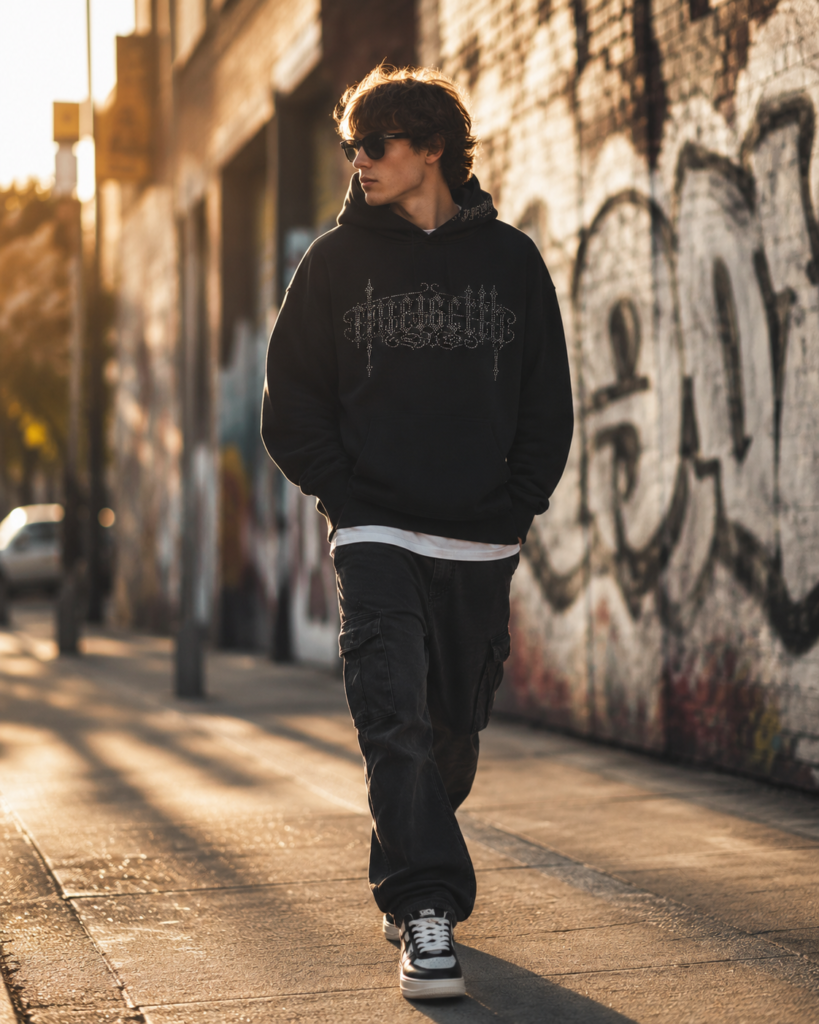
Where Mixed Emotion Fits in the Bigger Streetwear Picture
Streetwear used to be a small corner of fashion. Skaters wore it. Graffiti artists wore it. Hip-hop heads wore it. Everybody else stuck to whatever the department stores were pushing that quarter. But something shifted around 2016, and that shift hasn’t slowed down since. Independent labels started popping up with smaller runs, bolder graphics, and a willingness to say something real through fabric and thread. The streetwear market now sits well above 200 billion dollars globally, and a big reason for that growth is the emotional honesty these smaller brands bring. Traditional fashion tells you how to feel powerful, elegant, polished. Streetwear lets you show how you already feel, even when that feeling is complicated. A brand built around the idea of mixed emotion gets this better than most. Rather than pretending every customer walks into the day with a single clear vibe, it designs for the full spectrum loud rhinestone detailing for the confident mornings and muted acid-wash pieces for the quieter afternoons. That kind of range within a single label is rare, and it’s why emotionally-driven streetwear tends to build loyalty faster than logo-driven brands ever do. What also makes this wave different from earlier streetwear eras is the production quality. Early independent labels often cut corners on blanks, stitching, and packaging because margins were razor-thin. The current generation sources heavier cotton, uses reinforced flatlock seams at stress points, and pays attention to finishing details like metal-tipped drawstrings and woven labels instead of heat-pressed tags. You’re not just buying a vibe anymore. You’re buying a product that can handle a year of regular washing without falling apart, and that durability matters when a hoodie costs seventy dollars or more.
Why Your Wardrobe Needs Emotional Range
Think about the last week of your life. Monday might have felt focused and sharp. Wednesday probably dragged. Friday brought relief, maybe excitement. Your mood changed every single day, and yet most people open the same closet and reach for roughly the same outfit regardless of how they feel. That disconnect between internal state and external presentation is something streetwear is uniquely equipped to solve, because no other fashion category offers the same variety of tone within a single category of clothing. A graphic tee alone can range from aggressive and confrontational to soft and nostalgic depending on the print, the color, and the weight of the fabric. Hoodies shift even further. A heavyweight black hoodie with embellished lettering sends a completely different signal than a washed-out cream pullover with no graphics at all. Both belong in the same wardrobe, and both serve different emotional needs on different days. I personally think the biggest mistake people make when building a streetwear closet is buying five versions of the same mood. Five black hoodies with similar graphics gives you volume but zero range. You’d be better served by three hoodies in three different emotional registers one loud, one neutral, one somewhere in between because that trio covers far more of your actual week than five near-duplicates ever could. The concept of emotional range also extends to how pieces interact with each other. A bold top paired with relaxed, quiet bottoms creates a balanced outfit that feels intentional. Two loud pieces worn together can overwhelm, and two quiet pieces together can flatten into forgettable territory. Learning to pair emotional opposites within a single outfit is a skill, and it’s one that separates people who wear streetwear from people who understand it. That pairing instinct develops with practice, not with purchases.
Three Things to Check Before You Buy Any Streetwear Piece Online
Online shopping for streetwear is convenient, but it’s also where most disappointment happens. Photos are styled and lit to perfection. Descriptions use words like “premium” and “exclusive” without defining what those terms actually mean. And sizing varies so wildly between brands that your usual medium could fit like a small from one label and an extra-large from another. Before you add anything to your cart, run through these three checks to protect yourself from regret.
- Find the garment measurement chart not the generic size guide, but the actual body measurements in centimeters or inches for each size option, because comparing chest width and body length to a piece you already own and love is the single most reliable way to predict fit without trying something on.
- Look for real customer photos or unboxing content posted by actual buyers on social media, since studio product shots always use steaming, clipping, and careful lighting that makes even mediocre fabric look exceptional, while a phone photo in someone’s bedroom shows the garment as it actually arrives.
- Check the return and exchange policy before purchasing, especially on limited-edition or sale items, because many streetwear stores exclude discounted or special-release products from standard return windows, and learning that after the package arrives creates a frustration that could have been avoided entirely.
These three steps take less than five minutes combined, and they eliminate the vast majority of bad purchases. One observation from years of online buying: brands that openly list fabric weight in GSM, thread composition, and country of manufacture on the product page tend to deliver exactly what they advertise. Brands that bury or omit those details are often hiding something, whether it’s a lighter-than-expected blank or overseas stitching that doesn’t match the price point. Transparency before the sale almost always predicts satisfaction after it.
How Sneakers Anchor Everything Else You Wear
Footwear runs the show in streetwear. Full stop. You can wear the most thoughtfully assembled outfit imaginable, and if the shoes don’t match the energy, the whole thing falls flat. That’s because shoes sit at eye level when you’re seated, they’re the first thing people notice when you walk into a room, and they take more physical abuse than any other part of your outfit, which means they show their quality or lack of it faster than anything else. A strong sneaker rotation needs at least three pairs working at different energy levels. One pair stays clean, minimal, and versatile white or black leather in a simple silhouette that pairs with everything from joggers to tailored trousers. The second pair carries more personality, something with a bold colorway, a textured upper, or a brand identity that makes the shoe a conversation piece on its own. A pair from Amiri fills this role exceptionally well because the leather construction ages with character instead of deteriorating, and the design straddles casual and elevated without forcing you to commit to either extreme. The third pair is your beater the worn-in canvas or suede pair you throw on for errands, dog walks, or lazy weekends when comfort outweighs appearance. This three-tier rotation isn’t about spending a fortune. It’s about having options so you’re never forcing a shoe into a role it doesn’t fit. Here’s a limitation worth owning: even premium sneakers need rest days. Wearing the same pair daily compresses the midsole foam and traps moisture inside, both of which accelerate breakdown. Rotating pairs gives each shoe at least twenty-four hours to decompress and dry, and that single habit adds months of life to every pair you own. Cedar shoe trees help too, but rotation alone does most of the heavy lifting.
What Separates Good Tour Merch from Forgettable Souvenirs
Artist merchandise used to be disposable by design thin blanks, basic prints, sold at inflated venue prices to captive audiences. Nobody expected longevity because the shirt wasn’t really clothing. It was a receipt for an experience. That model still exists, but a newer approach has emerged alongside it, where artists and their teams treat merch as a genuine extension of the creative project. The gap between those two approaches is enormous, and knowing how to spot the difference saves you from spending fifty dollars on something that cracks and fades after three washes. Here are the markers that distinguish serious merch from throwaway souvenirs:
- Fabric weight above 200 GSM for tees and above 350 GSM for hoodies anything lighter feels papery on the body and shrinks noticeably after the first warm wash.
- Print placement that considers the garment’s shape rather than defaulting to a centered chest rectangle shoulder prints, back yoke graphics, and wrap-around designs signal a team that actually thought about how the piece looks when worn, not just how it looks folded on a table.
- Colorways chosen for wearability black, washed grey, natural cream, and deep navy survive daily rotation far better than bright novelty colors that limit your outfit options to “concert day only.”
- Sizing consistency across the full run a good merch line uses the same blank in every size, so a small and an XXL share proportions rather than one being cut slim and the other boxy because the manufacturer switched templates mid-production.
A line like zach bryan tour merch reflects the newer model well, where the designs connect to the music’s emotional tone without being literal album reproductions. When I pick up a piece of tour merch and the collar holds its shape after I stretch it with both hands, I know the blank was chosen with care. That two-second test tells you more than any product description ever will.
Color Pairing Without a Design Degree
Color intimidates people who didn’t grow up around art or design, but the actual rules for dressing well in streetwear are far simpler than the fashion industry wants you to believe. You don’t need to memorize a color wheel. You don’t need to know what “complementary” or “analogous” means. You need exactly one principle: pick one color to lead and make everything else quiet. If your hoodie is forest green, your pants should be black, charcoal, or cream. If your sneakers are bright, your top half should be neutral. This one-voice approach works because it gives the eye a clear place to land. When every piece competes for attention, the outfit looks noisy rather than styled. Monochrome fits where every piece lives in the same color family work equally well, but they need texture variation to avoid looking flat. An all-black outfit in three different textures (cotton, nylon, suede) reads as intentional and layered. An all-black outfit in three identical cotton pieces reads as “I didn’t try.” The textures do the work that color variety would normally handle. Earth tones are the easiest starting palette for anyone who feels unsure. Olive, tan, rust, and chocolate brown combine almost effortlessly, and they carry a grounded, natural feel that suits streetwear’s relaxed proportions. I’d personally recommend building your first intentional color palette entirely in earth tones before introducing brighter accents, because it trains your eye to see tone relationships without the distraction of vivid hues. One trap worth avoiding is “almost matching.” Two shades of blue that are close but not identical look like a mistake, not a decision. Either commit to the exact same shade across pieces or create enough contrast that the difference is obviously deliberate. That gap between “close” and “matching” is where most outfit confusion lives, and simply being aware of it prevents a surprising number of styling errors.
Layering Techniques That Actually Work in Warm Climates
Most layering advice assumes you live somewhere cold. Pile on the hoodie, add the jacket, throw a scarf over it, done. But what if your climate sits above eighty degrees for half the year? Layering still matters for streetwear in warm weather it just works differently. Instead of adding warmth, warm-climate layering adds dimension and visual structure to outfits that would otherwise look flat. The base principle shifts from insulation to transparency and proportion. Start with a lightweight, slightly oversized tee as your base. Over that, add an unbuttoned short-sleeve camp collar shirt in a contrasting color or pattern. The open front lets air circulate while the second layer adds visual depth without trapping heat. This two-piece combination is the warm-weather equivalent of a tee-plus-hoodie stack, and it works because the layers interact visually without actually overlapping on the body. Fabric choice becomes critical in heat. Stick to natural fibers cotton and linen breathe far better than polyester blends, which trap moisture against your skin and create that clammy feeling within minutes. A linen-blend overshirt weighs almost nothing and drapes loosely enough that you barely notice it’s there, but it gives your outfit a finished look that a standalone tee can’t achieve. Shorts play a bigger role in warm-climate streetwear than most style guides acknowledge. A pair of well-cut shorts with a seven-to-nine-inch inseam and a relaxed thigh opening replaces pants for five or six months of the year in hot regions. Pairing them with mid-cut sneakers and a layered top half creates a silhouette that’s proportional and interesting without overheating. One hands-on detail: if your overshirt’s hem hangs lower than your base tee when layered, the proportions flip and the outfit reads as sloppy. Always make sure the inner layer hangs slightly below the outer layer for that clean staggered hemline.
Building a Wardrobe You Won’t Regret in Six Months
Regret is expensive. Every impulse purchase that ends up unworn at the back of a drawer represents money, closet space, and decision energy wasted. Streetwear’s drop culture makes this worse because it manufactures urgency. The countdown timer. The “only 200 units” label. The social media preview that disappears after twenty-four hours. All of it is designed to make you buy before you think, and the brands know exactly what they’re doing. Fighting that pressure requires a system, not just willpower. The simplest system I’ve found is the three-outfit test. Before buying anything, mentally build three complete outfits using that piece and clothes you already own. If you can’t picture three combinations without straining, the piece doesn’t serve your wardrobe it just looks good in isolation. This test takes thirty seconds and prevents roughly eighty percent of regret purchases, based on my own experience tracking buys over the past four years. Beyond individual purchases, your wardrobe needs periodic auditing. Every three months, pull everything out and separate it into three piles: worn regularly, worn occasionally, not worn at all. The “not worn” pile tells you exactly where your buying habits misfire. Maybe you keep buying graphic tees when you actually reach for mixed emotion blanks and solids most mornings. Maybe you own six jackets but only rotate two. That data, gathered honestly from your own behavior, is worth more than any trend forecast or shopping guide because it reflects your actual life, not your aspirational one. Finally, accept that your taste will evolve. Pieces you loved two years ago may not fit your current aesthetic, and that’s healthy. Selling or donating those pieces frees up space and budget for things that match who you are right now, not who you were during a different phase.
Final Words
Your wardrobe tells a story whether you write it intentionally or not. Streetwear gives you a wider vocabulary than almost any other fashion category loud pieces, quiet pieces, sentimental pieces, luxury pieces, beaters. The trick isn’t owning all of them. It’s owning the right ones for your specific life and letting everything else pass. Buy less, choose better, and give yourself permission to feel more than one thing at a time. Your clothes can handle it.
FAQs
How many pieces does a functional streetwear wardrobe actually need? Around fifteen to twenty well-chosen pieces cover most people comfortably. That’s roughly four tees, three hoodies or sweatshirts, three pairs of pants, three sneakers, and a couple of accessories. Quality over quantity always wins here.
Is expensive streetwear always better than budget options? Not automatically. Price usually reflects fabric weight, construction quality, and brand positioning. A sixty-dollar hoodie in 400 GSM fleece with flatlock seams will outlast a hundred-dollar hoodie made from lightweight open-end cotton. Check the specs, not just the tag.
Can artist merch work as everyday clothing? Yes, if the merch is designed for it. Look for heavier blanks, muted colorways, and designs that reference the artist subtly rather than literally. Pieces that function outside the concert context earn their spot in a daily rotation.
What’s the best way to figure out my actual streetwear style? Track what you wear for thirty days. Photograph your outfit each morning. After a month, patterns emerge favorite colors, preferred fits, pieces you skip repeatedly. That data reveals your real style faster than any quiz or influencer recommendation.
How do I keep printed tees from cracking and fading? Wash inside out in cold water and hang dry. Heat is the enemy of screen printing both dryer heat and hot water accelerate cracking. If you must use a dryer, choose the lowest temperature and remove the tee while it’s still slightly damp.
Sites fetched: https://mixedemotionshops.com/, https://amirishop.com.mx/ (via site: search), https://zachbryanmerchs.com/
Links placed:
- Mixed Emotion → anchor: “mixed emotion” → https://mixedemotionshops.com/product-category/shirts/
- Amiri → anchor: “Amiri” → https://amirishop.com.mx/product-category/tenis-amiri/
- Zach Bryan Merchs → anchor: “zach bryan tour merch” → https://zachbryanmerchs.com/product-category/zach-bryan-tour-merch/